
There is a particular kind of record that refuses to be used as furniture. Put it on while you answer email and it will not cooperate — not because it demands anything loud, but because almost nothing in it arrives on the beat you expect. Pema Journey, released on 23 August 2026, is six pieces and a little over half an hour of music built by two artists who have spent their working lives on opposite approaches to the same question: what actually happens when a person listens.
Todd Boston and Silvia Nakkach have known each other for years. Boston, announcing the album, put the thesis plainly: music teaches us how to listen, not only to sound but to the space between the notes — and some of the deepest listening happens between two people who have known each other a long time.
The Guitarist Who Builds Rooms Alone
Boston's reputation rests on density. His instrument is advanced fingerstyle guitar run through live looping systems, a combination that sounds like a gadget and is in fact a discipline: years of right-hand independence and harmonic literacy before it produces anything anyone would want to hear twice. Onstage it lets one player assemble what sounds like a full ensemble in real time, layering parts as he goes, with wood flute, hand percussion and world instruments drawn in as a piece requires.
Looping has a default gravity, and most artists who use it get pulled toward electronic pulse or ambient wash. Boston's compositions have gone the other way, insisting on melody, on rhythmic complexity, and on the resonant behaviour of actual wood and string. His records have charted in Billboard's world and new age categories. Sitting between contemporary fingerstyle's polyrhythmic investigations and the devotional traditions of world music, his catalogue has never classified cleanly, which is usually a sign an artist is following something other than a format.
The Vocalist Who Made Listening a Curriculum
Nakkach arrives from an almost opposite direction. She is a Grammy-nominated musician and sound designer, trained as a vocalist in classical North Indian music, and a former music psychotherapist — a combination rarer than the individual parts suggest. She founded the International Vox Mundi School of the Voice and built its Sound, Voice and Music in the Healing Arts program at the California Institute of Integral Studies. She established schools of the Yoga of the Voice in Kobe and in Rio de Janeiro. Her book Free Your Voice is the practical distillation of the method.
Her stated vision is of music as a universal language and a vehicle for what she describes as quantum listening: a practice meant to expand awareness of sound across as many dimensions of attention as a person can hold. That is not a sentiment attached to the work afterwards. It is the work — she has spent decades building institutions to teach it.
So one artist spent a career learning to fill a room by himself, and the other spent a career teaching people what happens when they stop filling it.
Six Pieces, Thirty-One Minutes
The album runs to six tracks, none shorter than four minutes and two past six:
- Becoming — 4:49
- Essence — 4:00
- Moonlight — 6:41
- Poem — 6:15
- Pema — 4:57
- Reunion — 4:28
The sequencing is worth a moment. A record made by two old friends opens on Becoming and closes on Reunion, with the title track second from last. Boston has described the album as shaped by friendship, wonder, departure and return, and the running order carries that arc without needing to explain itself.
By the artists' own account the pieces are assembled from whispered voice, acoustic instruments and richly textured soundscapes, with raga-inspired melodies winding through them like threads of light. The raga influence matters structurally rather than decoratively. A raga is not a scale but a framework for unfolding — a set of rules about which notes may be approached, in what order, with what emphasis, so that a melody reveals itself by patient degrees around a tonal centre. That is close to the opposite instinct from loop-stacking, where the reward arrives through accumulation. On this album Boston is subtracting, and the subtraction is the interesting decision.
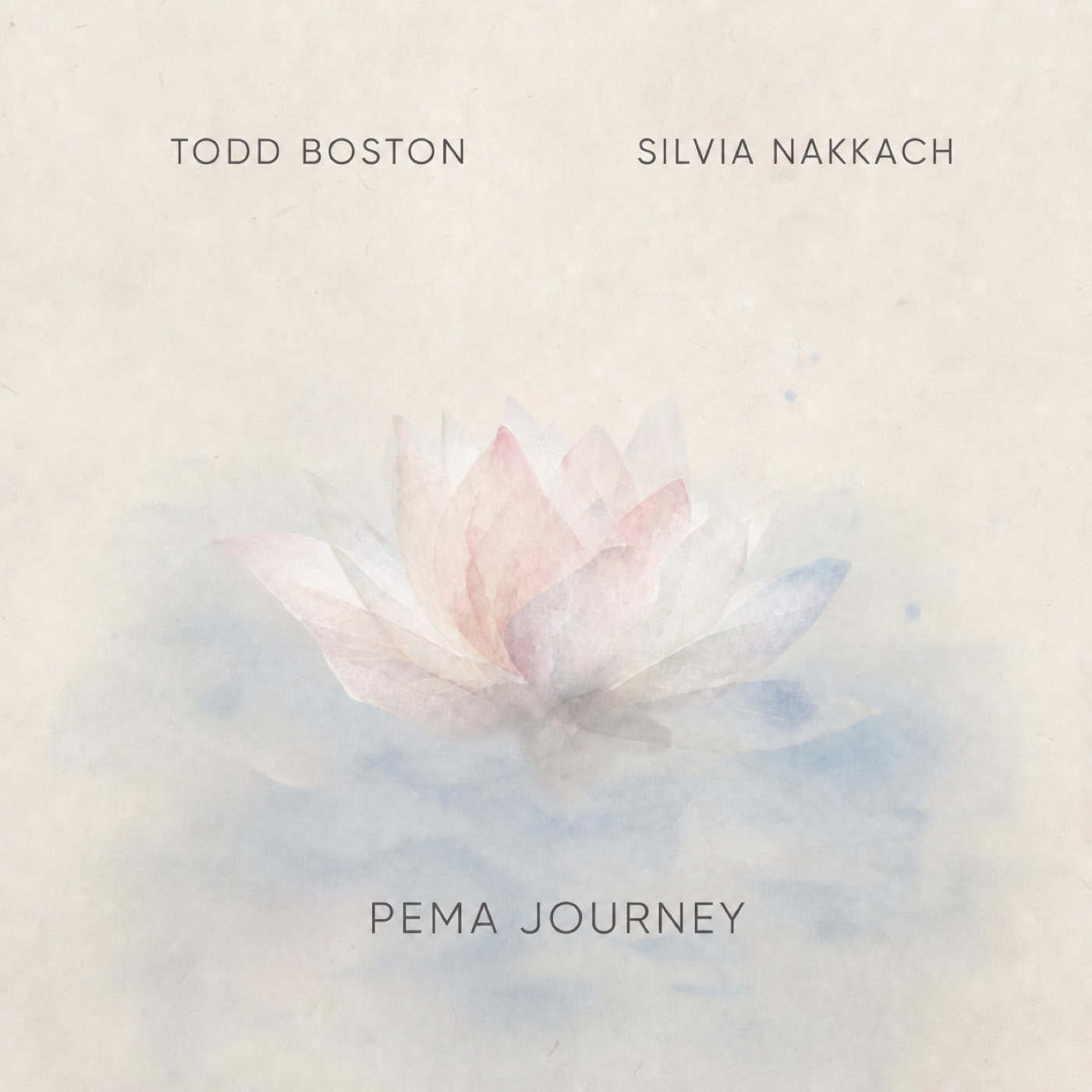
Pema translates to lotus — a flower that does its growing underwater, in the dark, and reaches the surface having already done the work. The title is not ornament either.
Listen to the Album
The complete album, in running order:
Bandcamp returns the most to the artists.
What the Record Asks of You
This is music paced for attention rather than for accompaniment, and Boston has been candid that this is deliberate: music, as he describes it, that asks not to be hurried but received. Each piece is intended to open a space for deep listening — a ceremony in sound, a quiet crossing into stillness, release and expanded awareness.
Whether it works on you is a question only listening answers. But the premise is unusually coherent for a collaboration record. Two musicians whose entire practice is the discipline of hearing properly — one through a loop pedal that hands back every hesitation exactly as played, the other through a curriculum built to widen what a person can perceive — made an album about the space around a note. The friendship behind it is audible in the most practical sense: neither part crowds the other.